Saturday, 30 May 2015

Testing Toxic Waters

As posted on the Toronto Media Co-op May 29 2015

Aamjiwnaang First Nation seeks to chart the pollution in their creek

"How polluted is the creek that runs through our community?" That is what members of Aamjiwnaang First Nation want to know and it’s an important question considering they live in an area known as Chemical Valley.
Through the years piecemeal studies have been done on the aquatic life, air as well as the residents themselves. The results have frequently been alarming. In 1996 the Ministry of the Environment recorded high levels of mercury in plant and marine life, in 2011 the World Health Organization listed neighbouring Sarnia as having the worst air quality in Canada, and a 10 year birth ratio study presented in 2005 showed an alarming trend that the number of boys being born was steadily declining.
But most recently representatives of the Ministry of the Environment and Climate Change (MOECC) presented a new report that said the local creek was fine to play in.
On May 14, five representatives of the MOECC presented the report: Screening Level Human Health Risk Assessment of Recreational Use of Talfourd Creek, Ontario at the Maawn Doosh Gumig Community and Youth Centre in Aamjiwnaang. The Ministry looked at water and sediment samples from a number of locations along the creek and tracked six chemicals; cadmium, manganese, titanium, polycyclic aromatic hydrocarbons, octachlorostyrene and 2,6-dichlorobenzyl chloride.
The representatives explained that from their test results Talfourd Creek should not be considered a danger, stating; “Based on the assessment in this screening level risk assessment, exposures to contaminants in Talfourd Creek reflect negligible additional risk to a frequent recreator” (a person who uses the creek for recreational purposes).
But these findings and the report's conclusion run contrary to the community's experience. Many of the people at the presentation cited examples of animals becoming sick after drinking the water, catching deformed fish, and children experiencing skin rashes after playing in the creek. They also asked if the Ministry examined the creek's plants and fish or factored in the cumulative effect of all the chemicals found in the water as well as air. The representatives conceded that these were not aspects of the study. The report’s summary acknowledges this limitation stating, “It is important to note that this risk assessment reflects only the additional risk a person would have from recreational use of Talfourd Creek, not the total risk a person would have from all sources of exposure to a contaminant in Lambton County.”
This latest Government report appears to be another in the growing list of inconclusive studies that neither reveals a reason for the resident's reported health issues nor convincingly proves that there are no hazards to living in the area. It is because of this that the youth led group ASAP (Aamjiwnaang and Sarnia Against Pipelines)   is spearheading a independent toxicity study. 
The group explains their rationale saying:
"It is important to empower ourselves as stewards of the water, as government and industry have downplayed, ignored and actively worked to repress information about water pollution in Chemical Valley. By conducting our own water testing of pollutants in our territories, we build the knowledge, skills, and resources to get answers about long standing questions about the level and nature of contamination in Aamjiwnaang."
Throughout the summer, members will be meeting with the community, taking samples of water and sediment from the creek, working with labs and university partners to examine the samples then compiling a report based on the results. In September they plan to have the project completed and are organizing a Toxic Tour to both present the results and provide a context to non-residents for why the project was needed.
To help fund the project, ASAP created a crowdfunding page  and updates to the project's progress will be posted on their web site.
Anyone interested in pollution, environmental justice, popular epidemiology, effects of the tar sands developments including its pipelines, is encouraged to join the Toxic Tour. Information about the event and how to sign up will be posted on the groups Facebook page.

Tuesday, 24 February 2015

New Report Says Racism Harms Health

as posted in Toronto Media Co-op Feb. 4 2015
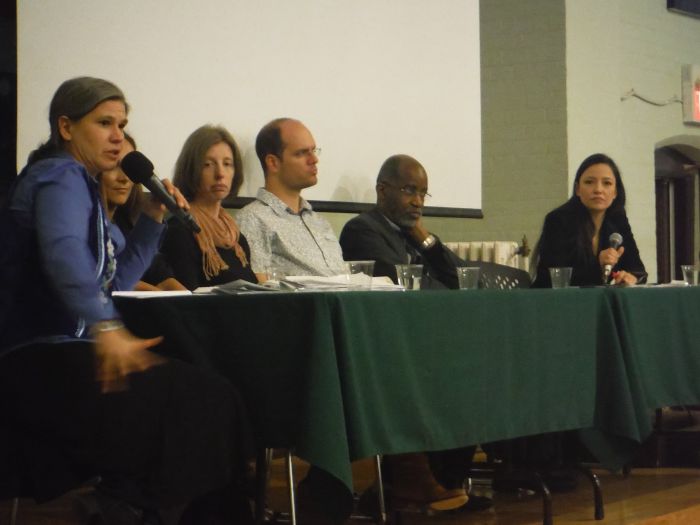
Dr. Janet Smylie, Dr. Ricci Harris, Dr. Donna Cormack, Dr. Yin Paradies, Dr. David R. Williams, moderator Connie Walker
Despite the cold and snow, people packed the Native Canadian Centre's auditorium on the evening of February 3rd. As the muted sounds of drumming vibrated up through the auditorium floor, people eat venison stew and fry bread, chatted with each other and prepared to discuss the issues raised in a new report calledFirst Peoples, Second Class Treatment: The role of racism in the health and well-being of Indigenous peoples in Canada.
      A joint effort between the Living Well Centre of St. Michael's Hospital, the Centre for Research on Inner City Health (CRICH), The Wellesley Institute, and Dalla Lana School of Public Health, the First Peoples’ report sought to answer the question; What are the fundamental ways in which racism is responsible for the alarming disparities in health between Indigenous and non-Indigenous people?
     The events attendees, made up of equal parts university students, older academics and Native youth and elders, agreed that racism, as a product of colonization, is a very real problem in Canada. This is despite the outward portrayal of Canada as an inclusive, multicultural nation. While pinpointing exactly how it is manifest can pose a challenge, merely acknowledging that racism is a factor which inhibits the equal distribution of services is crucially important.
      To provide an international perspective, the report’s co-authors, Dr. Janet Smylie, a Metis physician at St. Michael's hospital and director of the Well Living House and Dr. Billie Allan a Postdoctoral Fellow and Research Associate at the Well Living House and the Centre for Research on Inner City Health, were joined by four visiting academics.
      Dr. Yin Paradies from Australia explained how racism can be difficult to study as the effects may be unseen or subtle.
     However, Dr. David R. Williams of the U.S explained the need for researchers to push their work further as the few studies that have been completed on the subject show that racism has a greater impact than class in its effect on health.
     Dr. Williams also acknowledged how researchers frequently encounter resistance from funding bodies and government officials when their work is explicitly on racism. He explained the game of renaming reports or conferences to appease these powers, while maintaining the substantive content of the work.
     Doctors Ricci Harris and Donna Cormack from New Zealand completed the panel. Dr Harris made the distinction that as a physician and researcher, it is essential not to individualize behavior, but to see the overarching effect of racism as one of the important determinants of people’s health.
     The event was organized as more of a community meeting than panel discussion among these experts. Many questions, comments and experiences were shared by the assembled group. Although time was limited, the organizers made sure to acknowledged that the community is full of ‘experts’ who live this reality daily and that any research of this sort must foreground the lived experiences of those who had historically been treated as mere subjects.
      When a community member asked how to get the pervasiveness of racism onto the political agenda in hopes of mandating real change, Dr. Smiley pointed to the consciousness raising of Idle No More. She explained that after the continued pressure from the movement and actions of Chief Theresa Spence, social service organizations and funding bodies realized there was a need for more work to be done. That realization made it easier for her to launch the First Peoples project.
     Dr. Smiley’s observation underscores the importance of sustained political pressure from grassroots movements. Not only has Idle No More help put Native demands in the mainstream media, by opening a window of opportunity for funding research projects, the movement is having a ‘trickle-up’ affect into the world of academia and policy advisory.
The full report can be found on the Wellseley Institute’s website here and a summary version here.