Saturday, 30 May 2015

Testing Toxic Waters

As posted on the Toronto Media Co-op May 29 2015

Aamjiwnaang First Nation seeks to chart the pollution in their creek

"How polluted is the creek that runs through our community?" That is what members of Aamjiwnaang First Nation want to know and it’s an important question considering they live in an area known as Chemical Valley.
Through the years piecemeal studies have been done on the aquatic life, air as well as the residents themselves. The results have frequently been alarming. In 1996 the Ministry of the Environment recorded high levels of mercury in plant and marine life, in 2011 the World Health Organization listed neighbouring Sarnia as having the worst air quality in Canada, and a 10 year birth ratio study presented in 2005 showed an alarming trend that the number of boys being born was steadily declining.
But most recently representatives of the Ministry of the Environment and Climate Change (MOECC) presented a new report that said the local creek was fine to play in.
On May 14, five representatives of the MOECC presented the report: Screening Level Human Health Risk Assessment of Recreational Use of Talfourd Creek, Ontario at the Maawn Doosh Gumig Community and Youth Centre in Aamjiwnaang. The Ministry looked at water and sediment samples from a number of locations along the creek and tracked six chemicals; cadmium, manganese, titanium, polycyclic aromatic hydrocarbons, octachlorostyrene and 2,6-dichlorobenzyl chloride.
The representatives explained that from their test results Talfourd Creek should not be considered a danger, stating; “Based on the assessment in this screening level risk assessment, exposures to contaminants in Talfourd Creek reflect negligible additional risk to a frequent recreator” (a person who uses the creek for recreational purposes).
But these findings and the report's conclusion run contrary to the community's experience. Many of the people at the presentation cited examples of animals becoming sick after drinking the water, catching deformed fish, and children experiencing skin rashes after playing in the creek. They also asked if the Ministry examined the creek's plants and fish or factored in the cumulative effect of all the chemicals found in the water as well as air. The representatives conceded that these were not aspects of the study. The report’s summary acknowledges this limitation stating, “It is important to note that this risk assessment reflects only the additional risk a person would have from recreational use of Talfourd Creek, not the total risk a person would have from all sources of exposure to a contaminant in Lambton County.”
This latest Government report appears to be another in the growing list of inconclusive studies that neither reveals a reason for the resident's reported health issues nor convincingly proves that there are no hazards to living in the area. It is because of this that the youth led group ASAP (Aamjiwnaang and Sarnia Against Pipelines)   is spearheading a independent toxicity study. 
The group explains their rationale saying:
"It is important to empower ourselves as stewards of the water, as government and industry have downplayed, ignored and actively worked to repress information about water pollution in Chemical Valley. By conducting our own water testing of pollutants in our territories, we build the knowledge, skills, and resources to get answers about long standing questions about the level and nature of contamination in Aamjiwnaang."
Throughout the summer, members will be meeting with the community, taking samples of water and sediment from the creek, working with labs and university partners to examine the samples then compiling a report based on the results. In September they plan to have the project completed and are organizing a Toxic Tour to both present the results and provide a context to non-residents for why the project was needed.
To help fund the project, ASAP created a crowdfunding page  and updates to the project's progress will be posted on their web site.
Anyone interested in pollution, environmental justice, popular epidemiology, effects of the tar sands developments including its pipelines, is encouraged to join the Toxic Tour. Information about the event and how to sign up will be posted on the groups Facebook page.

Tuesday, 24 February 2015

New Report Says Racism Harms Health

as posted in Toronto Media Co-op Feb. 4 2015
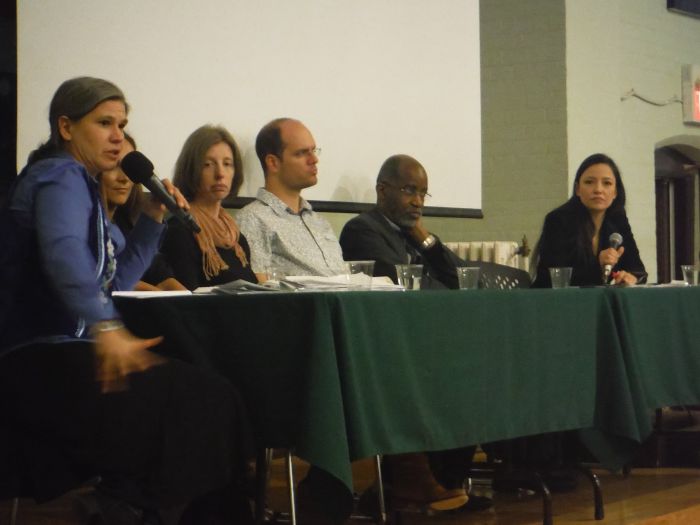
Dr. Janet Smylie, Dr. Ricci Harris, Dr. Donna Cormack, Dr. Yin Paradies, Dr. David R. Williams, moderator Connie Walker
Despite the cold and snow, people packed the Native Canadian Centre's auditorium on the evening of February 3rd. As the muted sounds of drumming vibrated up through the auditorium floor, people eat venison stew and fry bread, chatted with each other and prepared to discuss the issues raised in a new report calledFirst Peoples, Second Class Treatment: The role of racism in the health and well-being of Indigenous peoples in Canada.
      A joint effort between the Living Well Centre of St. Michael's Hospital, the Centre for Research on Inner City Health (CRICH), The Wellesley Institute, and Dalla Lana School of Public Health, the First Peoples’ report sought to answer the question; What are the fundamental ways in which racism is responsible for the alarming disparities in health between Indigenous and non-Indigenous people?
     The events attendees, made up of equal parts university students, older academics and Native youth and elders, agreed that racism, as a product of colonization, is a very real problem in Canada. This is despite the outward portrayal of Canada as an inclusive, multicultural nation. While pinpointing exactly how it is manifest can pose a challenge, merely acknowledging that racism is a factor which inhibits the equal distribution of services is crucially important.
      To provide an international perspective, the report’s co-authors, Dr. Janet Smylie, a Metis physician at St. Michael's hospital and director of the Well Living House and Dr. Billie Allan a Postdoctoral Fellow and Research Associate at the Well Living House and the Centre for Research on Inner City Health, were joined by four visiting academics.
      Dr. Yin Paradies from Australia explained how racism can be difficult to study as the effects may be unseen or subtle.
     However, Dr. David R. Williams of the U.S explained the need for researchers to push their work further as the few studies that have been completed on the subject show that racism has a greater impact than class in its effect on health.
     Dr. Williams also acknowledged how researchers frequently encounter resistance from funding bodies and government officials when their work is explicitly on racism. He explained the game of renaming reports or conferences to appease these powers, while maintaining the substantive content of the work.
     Doctors Ricci Harris and Donna Cormack from New Zealand completed the panel. Dr Harris made the distinction that as a physician and researcher, it is essential not to individualize behavior, but to see the overarching effect of racism as one of the important determinants of people’s health.
     The event was organized as more of a community meeting than panel discussion among these experts. Many questions, comments and experiences were shared by the assembled group. Although time was limited, the organizers made sure to acknowledged that the community is full of ‘experts’ who live this reality daily and that any research of this sort must foreground the lived experiences of those who had historically been treated as mere subjects.
      When a community member asked how to get the pervasiveness of racism onto the political agenda in hopes of mandating real change, Dr. Smiley pointed to the consciousness raising of Idle No More. She explained that after the continued pressure from the movement and actions of Chief Theresa Spence, social service organizations and funding bodies realized there was a need for more work to be done. That realization made it easier for her to launch the First Peoples project.
     Dr. Smiley’s observation underscores the importance of sustained political pressure from grassroots movements. Not only has Idle No More help put Native demands in the mainstream media, by opening a window of opportunity for funding research projects, the movement is having a ‘trickle-up’ affect into the world of academia and policy advisory.
The full report can be found on the Wellseley Institute’s website here and a summary version here.

Wednesday, 3 September 2014

People’s Tribunal seeks to Counter Canadian Pro-Mining Spin

(as first appeared in Upside Down World, June 26 2014)

Guilty of human rights abuses. That was the verdict for Canadian mining companies, after two days of in-depth testimony presented in Montreal, Quebec, to a jury of eight experts from around the world.
 
     The Montreal session of The Permanent People’s Tribunal, held from May 30 to June 1, continued a long history of civil society tribunals that started in Italy in 1979. The mandate of the sessions is to examine situations where “legal systems are unable to guarantee universal and effective respect for human rights.” This particular Tribunal will span two years, with the Latin America session being the first of its regional focuses. The session heard activist testimony from Chile, Honduras, Guatemala, Ecuador and Mexico as well as from Canadian civil society groups.
     So why Montreal?
     Canada is home to over 75% of all registered mining companies and in recent years there has been a concerted push by industry and government to further entrench Canadian mining operations at home and globally. The tribunal helped challenge the PR spin of these companies, and also highlighted the Canadian government’s role in supporting them financially, judicially and politically.

Mining Company Charges
     An adult education facility by the Lachine canal was transformed into a media hub complete with simultaneous translation into English, Spanish and French, a live stream of the proceedings on Concordia University’s website CUTV, ongoing radio and television interviews and rows of people busily working on laptops. In addition to the Latin American witnesses there were approximately 80 attendees comprised mostly of people from eastern Canada and nearby American states. To counter the sombre, often infuriating testimony, the organizers held a cultural event with music and dancing after the second day of testimony. 

Lina Solano Ortiz of Ecuador gives a radio interview.
     The first day heard charges against specific Canadian mining companies. These charges were grouped into three categories: the right to a healthy environment, the right to self determination and the right to full citizenship. Quebec educator Paul Cliche, acting as the prosecutor, explained that the cases being represented should be understood as “emblematic” and mere “examples of systemic issues” in the practises and governance of mining operations.
     Among those testifying about health and environmental concerns was Pedro Landa, the Coordinator of the Human and Environmental Rights program at the Honduran Center for the Promotion of Community Development (CEHPRODEC), along with Carlos Amador, a member of the Environmental Committee of the Valle de Siria in Honduras. They described how Goldcorp’s San Martin mine (which has been closed since 2008) continues to cause dire health problems for surrounding communities due to water contamination. Amador explained that Goldcorp’s mine is “destroying the dignity of our towns.” 
     Oscar Morales, coordinator of the Committee in Defense of Life and Peace, provided testimony and pages of evidence outlining the numerous “consultas” (traditional public opinion polls) that have unanimously rejected mining in his area of Guatemala. Mining companies such as Tahoe Resources, with their Escobal mine, have continued to operate without community approval, a direct violation of the right to free, prior and informed consent. 
Oscar Morales of Guatemala shows the results
of a recent consulta on mining.
     Lina Solano Ortiz, founder of the Front of Women Defenders of Pachamama, Ecuador, discussed the "masculinisation" of communities around mine sites. She outlined the changing dynamic of many women’s lives when a mine opens and noted that, “food sovereignty is sustained largely by women [but] when the economy shifts from agriculture and animal husbandry to mining, they become more dependent on men to support the families.” This subservient role may also lead to prostitution as groups of mainly single male mine workers move into small communities. Rising inequality has a disenfranchising effect on women both economically and politically.
     From Mexico, Dante Lopez and Juan Rodriguez spoke of unsafe working conditions and union busting activities at the La Platosa mine run by Excellon Resources and Jose Luis Abarca discussed the social conflict and repression surrounding Blackfire Exploration’s Payback mine, which culminated in the assassination of his father, Mariano Abarca.

State Actions
     Many of the companies accused of human rights abuses during the hearings also have contested mines in other parts of the world. In order to acknowledge the similarities between the practises of various companies, the Tribunal dedicated the second day to examining the role of government in permitting the global spread of mining companies. Their goal was to answer the question, "How is Canada supporting the expansion of the global mining industry?"
     The charges against the Canadian state included interference in the legislative process, financial support and gaps in access to justice. From the testimonies, it became clear that the host states were also at fault. Thus, the jury found that both Canadian and Latin American states are guilty, saying that they have “by act and omission … failed in their obligation to protect human rights and to prevent and sanction violations, particularly those related to Canadian mining companies.” 
     Nancy Yañez, a lawyer and professor at the University of Chile, gave testimony on how free trade agreements are overriding the rights of indigenous peoples as enshrined in international treaties such as the UN's International Labour Organization convention 169 (ILO 169). As she noted, “The right to self determination is fundamental to allow all other rights. But this is being limited by international agreements.” The result is a privileging of economic rights over democratic rights.
     Pedro Landa described specific government actions in recent years. He believes that the Canadian government required Honduras to change its laws on mining before the recent Canada/Honduras free trade agreement was finalized. Due to public outcry, there had been a moratorium on metallic mining in place since 2006 but the new law allows open pit mining such as Goldcorp’s San Martin mine to resume.
     The state's unwavering financial support through government corporations such as Export Development Canada and the Canada Pension Plan, as well as the negligible supervision of the financial markets, have provided loans, insurance and a source of equity that are not contingent on a company's adherence to internationally agreed upon best practises. These financial structures led Quebec professor and author Alain Deneault to describe Canada as being the “haven of choice for the world’s mining industries.”
     Those “gaps in access to justice” also prevent individuals or communities outside of Canada from laying charges against mining companies. Osgoode Hall Law School professor Shin Imai argued that these cases should be heard in the company’s home country rather than the host country. However, Imai went on to explain the two main obstacles to bringing a case to court in Canada: the enormous costs and the fact that “none of [the large law firms] can touch any of the cases because they have mining clients.” This leaves small firms that focus on social justice to take on the cases for distant plaintiffs.

The Verdict
     After two days of testimonies, the jury members delivered their verdict and found the following companies guilty of human rights abuses:
· Barrick Gold and its subsidiary Nevada Spa Mining
· Goldcorp and its subsidiary Entre Mares
· Tahoe Resources and its subsidiary Minera San Rafael
· S.A., Blackfire Exploration and its subsidiary Blackfire Exploration México S.A. de C.V.
· Excellon Resources Inc. and its subsidiary Excellon de México S.A. de C.V.

Pedro Landa of Honduras with jury member Gianni Tognoni.
     The jury included Maude Barlow, National Chairperson of the Council of Canadians, Mireille Fanon-Mendès-France, President of the Frantz Fanon Foundation in France, Viviane Michel, former Director of the Innu Nation of Quebec Native Women, Javier Mujica Petit, author and President of the Center for Public Policy and Human Rights in Peru and Gianni Tognoni, the Secretary General of the Permanent Peoples’ Tribunal.
     The jury also found that “The Canadian state and the countries in which these companies are operating are also at fault for not having prevented and for having facilitated, tolerated or covered up these human rights violations.” However, the jury was careful to reaffirm that “Canadian mining expansion in Latin America would not have been possible without the promotion and direct involvement of the Canadian state.”
     Although this session of the Montreal Permanent People’s Tribunal was only dedicated to Latin America, the resounding guilty verdict, and the round of applause that followed, is a clear message of Canadian disapproval. Concurrently, the rise of land defence movements such as Idle No More and anti-pipeline groups, as well as organizations calling for divestment from mining companies is turning an increasingly critical eye on the industry and state. Just as Barrick Gold, once one of the world’s largest gold companies, has recently lost some of its sheen and been forced to restructure, so too is the status quo within Canada being challenged from at home and abroad.
(all photos by the author)

Sunday, 6 July 2014

Toxic Neighbours

A Tour of Aamjiwnaang First Nation and the Petrochemical Plants Around it


(article first appeared on the Toronto Media Co-op's site, May 14 2014)

The borders of Aamjiwnaang have been reduced over the years to where they are currently, just over 12 km2. A large portion cutting into the community's scenic waterfront area is now home to one of Suncor's refineries. Its numerous smoke stacks and flares tower over the surrounding trees. While standing on the road near the plant, the smell is formidable. So is the noise. Most of the industries in the area operate 24 hours a day, 7 days a week. There is no respite for your ears or nose and lungs. By the time the Toxic Tour got to the main entrance of Suncor, about an hour into our walk, my head was already pounding.


The community youth group, ASAP (Aamjiwnaang and Sarnia Against Pipelines), lead by Vanessa Gray, organized a disparate group of about 40 people on a tour to show what daily life on the reserve is like. The walk began at the Maawn Doosh Gumig Community and Youth Centre and worked its way to the St. Clair River, around a refinery and back to the centre. Participants held banners saying "Demand more from your Ministry of the Environment", "Cancer Alley" and two large snake puppets. The snakes, one blue and shiny, the other black and dripping represented the two combating forces of clean water and oil products being transported through the many existing and proposed pipelines.


A small road branches off Vidal St., the main road along the river, and wraps around the side of Suncor's refinery. The facility was modified in 2008 to refine heavier crude oil that is shipped in from the tar sands. There among the stacks and enormous holding tanks is the graveyard currently in use by the Aamjiwnaang community. It is surrounded by Suncor on two sides, a highway on another and the site of Suncor's proposed ethanol plant on the fourth. There is very little room left for the community to continue keeping families and loved ones together. Norm, a member of the ASAP group, explained that although this is the graveyard currently in use, traditional burial sites were all along both sides of the St. Clair. Many were disrupted by the construction of industry and the large Blue Water Bridge which connects Ontario to Michigan. Lindsay Gray, shouting to be heard, explained that in addition to past graves being unearthed, the constant noise of the machines and regular sirens prohibit the gravesite from being a serene place for her ancestors. She asks the rhetorical question, "Whatever happened to rest in peace? Is this respectful?"

In 2004, the community succeeded in stopping Suncor's plans to build what would have been one of North America's largest ethanol refineries. The proposal was a tipping point and caused them to rally together to prevent another facility being built next-door to their houses. For days Aamjiwnaang members blockaded the road in protest. The pressure helped persuade Suncor to utilize an alternative site further to the south by Mooretown.

As the tour moved along, Zak, a resident of Sarnia and independent environmental monitor, pointed to an area along the road that crosses Talfourd Creek and leads back into Aamjiwnaang. It was recently discovered that an underground benzene pipeline had been slowly leaking. The cleanup is ongoing and orange plastic fences now block off the areas. Benzene is one of many aromatic hydrocarbons that have been leaked into the ground and air all too frequently. It is also considered a human carcinogen, being a cause of leukemia and other cancers. In 2009, Imperial Oil had an accident in which a "material containing benzene" was released causing a shelter-in-place order for residents in the extended perimeter of the plant. More recently, in 2013, a tanker ship unloading at the dock of Lanxess spilled four to five gallons of ethyl benzene into the St. Clair River.


But those are considered accidents. Regular, government approved, emissions from many of the factories contain a host of chemicals. The World Health Organization released a report in 2011 that charted air quality in urban settings around the world. Sarnia registered the most polluted air in Canada. Although the individual plant's emissions are bad but usually within the Ministry of Environment's parameters, the individual facilities do not operate in a vacuum. The pollution from the area's 60+ factories is combined; the cumulative effect is a problem that Aamjiwnaang community members are concerned about. So concerned that in 2011 they started a law suit.

Ada Lockridge  and Ron Plain together with lawyers from Ecojustice, filed a suit against the Ontario Government claiming their Charter Rights are being violated, in particular their, "rights to life, liberty and security of the person, and the right to equality". Ecojustice explains the case by saying the community members "believe that Ontario must consider the cumulative impacts of pollution in Chemical Valley before approving more toxic emissions".

There has yet to be an exhaustive study of the impact air borne and water pollution has on the community. But some things have been well documented, such as the skewed birth ratio of two girls being born for every one boy. This anomaly is attributed to hormone disrupting chemicals such as PCBs, dioxins and pesticides, some of which are now banned but can remain in the environment for years.


Also, high levels of mercury have been found in the blood and urine of some Aamjiwnaang members and a community led survey reported asthma levels in adults and children far exceeding that of surrounding communities. Many of the health and environmental studies which show these results state that a link to the industry present all around Aamjiwnaang cannot be definitively made. It is an argument I can understand rationally but as I was standing with my headache, in the stink of Suncor, reading the warning sign posted at Talfourd Creek and hearing Vanessa say that when she was growing up, all the kids played in the creek, it was impossible for me not to make the connection between the industry and the negative health effects.

The charter challenge with Ecojustice is slowly making its way through the legal system. Suncor, one of the companies cited, has been tapping into their immense capital reserves to mobilize lawyers who are fighting the charge at every stage. It will be a long battle but in the mean time, members of Aamjiwnaang are living in what Lindsay sees as “chemical warfare”, an extension of Canada's genocidal policies toward First Nations.


My hotel was north, along the St. Clair River, where the air does not stink and the cargo ships that glide along the horizon are like the industry to the south; a distant spectacle. I considered the history of the Blue Water community which was situated between Sarnia and Aamjiwnaang. It began in the 1940’s as housing for chemical plant workers and grew into a town of its own, reaching a peak population of over 2,000 people. But in 1966 the community was disbanded and all the residents relocated, largely to the north end of Sarnia, due to “health and safety concerns”.


It seems unjust to find a town full of factory employees too dangerous to live in, while the Native reserve just down the road is left to gasp for air and parents tell their children ‘don’t touch the water’. North Sarnia, with its lush golf course, yachts, and luxury cars reminds me that the petrochemical industry can be lucrative to some but toxic to many others.


Thursday, 27 March 2014

Garifuna Women Stake their Claim

Garifuna land along the north coast of Honduras is experiencing an unprecedented development rush. Tourism projects financed by state and international capital such as that of Canada's 'Porn King' Randy Jorgensen with his 'Banana Coast' project, sprawling African palm plantations, as well as the expansion of neighboring urban centers are increasingly usurping ancestral, communally held lands. The community of Triunfo de la Cruz is actively resisting these encroachments by asserting their collective right to the land using legal channels as well as physically occupying the perimeter lands to maintain current borders.

The women's agrarian collective, the Voice of Women, is one such group that is holding back encroachments. A group of 22 women maintain as many plots of land which they have cleared and are cultivating yucca plants on. Much of this area in included in a land dispute between the community and the Honduran government. In 2003 residents initiated a case with the Inter-American Commission on Human Rights (IACHR) which claimed the government was negligent in its duty to protect the ancestral Garifuna land as well as not acquiring free, prior and informed consent for the current developments in and around their community. Some of these developments are the Micos and Marbella tourism projects, as well as a large nature reserve, all of which severely restrict, if not completely remove, the land from Garifuna control and usage. The case is slowly working its way through the system with the latest milestone being the 2013 acceptance by the IACHR to hear the case in its courts. The community is now preparing the evidence needed to argue their case as well as raising funds to cover the costs of sending members to Costa Rica where the case will eventually be heard.

Sisters Beatrice and Olivia are two of the women who work plots in the women's collective and have testified before the IACHR. Olivia’s nickname within the community is "Mother Earth", a nod to her dedication to the protection of their land. The two women and the other collective members work long hours on their plots, weeding and nurturing the plants but many must travel a maze of roads to access the land.


Teresa, a member of the collective as well as a founding member of the community’s land defense committee, leads the group I was part of to a small gate in the high cider block fences. Inside are armed private security guards in the employ of the absentee investors. Many large buildings have been constructed within the cordoned off lands despite the ongoing dispute over land title. The women’s determination to continue working their fields and the daily trek along the circuitous roads, past the guards, in and of itself, is an act of defiance. 


However, not all of the fences that are built remain standing. During our visit, a new barbwire fence had been strung up blocking off the beach from the fields. Members of the women’s collective, who believe it was built by workers of the Marbella project, assert that they are illegal and use their sharp machetes to chop down the support posts. The fence will soon be rebuilt but the women's act is another way of resisting the incursions.

As well as the coastal tourism projects, the expansion of African palm plantations is putting pressure on the community from further inland. Honduran millionaire Miguel Facusse, through his extensive Dinant Corporation, holds contested titles to large swaths of land in the northern part of the country. Most of this land is used to grow African palm, the oil of which is used in a wide variety of processed foods and to a lesser extend in the manufacture of biodiesel. Many of the plantation’s processing facilities are also part of the international carbon credit trading industry. This seemingly 'eco-friendly' initiative ignores the fact that the promotion of non-native, monoculture plantations is irreparably damaging the soil in addition to the land disputes both within coastal Garifuna communities and areas such as the Bajo Aguan where numerous activist campesinos have been assassinated.


Conversely, the yucca that the collective grows is a native plant and they employ organic farming techniques. Additionally, it is largely for consumption within the community itself. A small portion will be sold to neighbouring communities but most ends up at the public kitchen back in the centre of Triunfo de la Cruz. The kitchen is a small brick building with ventilation holes blackened by the coal fired stoves that burn within. There, women dry, grind, then fry the yucca, making cassava bread. The community was connected to the electricity grid only in 1980 but access to machinery is still limited resulting in most of the work being done manually.

The Voice of Women collective is held up as an example of not only how to resist land usurpation, but as a means of establishing food sovereignty. A resident of nearby Sambo Creek praised the women’s collective and described her desire to establish a similar one, saying, “They have crops and food and they don’t have to buy their yucca, or cassava bread or plantains. Not like here, where we have to buy everything”1. Her community is also struggling with land loss despite a favourable State ruling in 2003. A model such as the Voice of Women could be a way to maintain the land conceded back to the community as well as feeding them.

Teresa shrugs off the notion that the women in the agrarian collective, such as herself, are leading the land reclamation fight, saying, “It’s part of our (Garifuna) culture, women are in all our struggles”. Certainly in Triunfo de la Cruz, the women are making their resistance known.


1 as quoted in Brondo, Keri Vacanti, (2010) “When Mestizo Becomes (Like) Indio… or is it Garifuna? Multicultural Rights and “Making Place” on Honduras’ North Coast”. Journal of Latin American and Caribbean Anthropology. Vol. 15, No. 1, page 189

Friday, 2 August 2013

San Jose Del Golfo, Guatemala.


 July 8, 2013.
We drove under this large banner at the entrance to San Jose Del Golfo. The message is quite clear, No Mining!
The community has been resisting the development of Canada's Radius Gold's gold and silver mine since 2010. On March 2 of this year, one woman took matters into her own hands after the community's repeated attempts to meet with local officials and representatives of Radius failed. She drove her pickup truck across the road which enters the mine site. Although she did not stop traffic for long, the community embraced the idea of a blockade and have been refusing entry to the site since that day.
I was excited to see upwards of 250 people, many vehicles and temporary shelters including a bathroom and kitchen set up along the road. Approximately two thirds of the people were women, many appeared to be seniors. Banners demanding an end to mining hung from the trees and fence along the road. Many of the banners were hand made, others from NGOs such as the Comite de Unidad Campesina (CUC), and Madres Selva who have instrumental in accessing information such as the environmental impact assessment report Radius submitted in order to receive their exploration license.
Jorge Lopez welcomed us on behalf of the crowd, and he and Antonio Reyes Romaro explained why the citizens of San Jose Del Golfo and the surrounding communities are committed to maintaining the blockade.
In 2010, lands on the site now known as Progresso 7 where rented under the auspices of improving local agriculture and a pineapple field. However, once the citizens began seeing truck loads full of rock and earth being removed, they realised what was actually happening and began researching the process for precious metal mining and the claim on this site in particular.
Radius Gold, through their Guatemalan subsidiary, Exmingua, have received an extraction license for a 20 square kilometre site which spreads into three municipalities. San Jose Del Golfo is the closest community, however, there are 4 smaller villages in the valley below which would be more immediately impacted by mining activities occurring above them.
The citizens are demanding a consultation be performed which would include all of the communities around the site. To date they have had to piece together information gathered by NGOs and the occasional propaganda leaflet circulated by the company. Lopez explained that details in the environmental impact assessment is either incorrect or too vague to fully understand.
Communities from other parts of Guatemala who are also currently resisting mining operations have been in consulted and supported the San Jose Del Golfo members but pressure to end the blockade has been steadily mounting. On July 13, a woman was driving home from the blockade when a motorcycle with two men pulled alongside her truck and shot at her four times. One bullet struck her but she is expected to recover from the injury. Other women reported being threatened and a 'black campaign' has been launched against them, seeing rumours spread that they are working at the blockade in order to have illicit affairs with men. These smears have even been forwarded to some women's husbands working out of state.
The group's message to us was for the people of Canada to pressure our government to pressure the Guatemalan government to retract the mining license. They said, they do not care if Canada cuts aid programs as a tool for said pressure, because the money does not get to the needy anyway.
After a lunch of tortilla, beans and pasta, we parted ways, leaving the citizens working the blockade to endure not only Guatemala's rainy season, but its political corruption and impunity which allow the country's laws to be good on paper, but infrequently enacted.

Sunday, 8 November 2009

Salvadoran School Children get a Helping Hand


The school year is well underway for children across the Americas. But this year in El Salvador, families’ task of outfitting and feeding their children is being made a lot easier.

In August, Vice President and Minister of Education, Salvador Sanchez Ceren announced a program to supply two school uniforms, one pair of shoes, and a set of school supplies to every public school student in the country. This new program will aid 1,360,000 children.

In addition, the FMLN has broadened the existing school meal program. Previously, the program was offered only to children in rural areas with high levels of poverty. It has now been expanded to include low income families in urban settings. The expansion adds over 450,000 children.
The FMLN’s policies of universal inclusion are a stark contrast to those of ARENA. During the lead up to the March presidential elections, radio reports from rural communities in the northern departments of Chalatenango and Cuscatlan, accused ARENA candidates of offering fabric for children’s school uniforms in exchange for votes. These election bribes are symptomatic of ARENA’s actions through out their reign. Their supporters were rewarded and opponents left wanting, increasing the already wide divide between those living above the poverty line and those below.

Photo from CISPES www.cispes.org